What would you do if your medicine cost $1,300 a month and you just lost your job?
This happened to someone I know, and it happens to real people in our communities every day — in Johnston, Harnett, Sampson, Bladen, Brunswick, and Pender counties. These are people who work hard, raise kids, and do their best to stay healthy. But when they lose a job, they often lose their health insurance too. And suddenly, medicine they need to stay alive is simply out of reach.
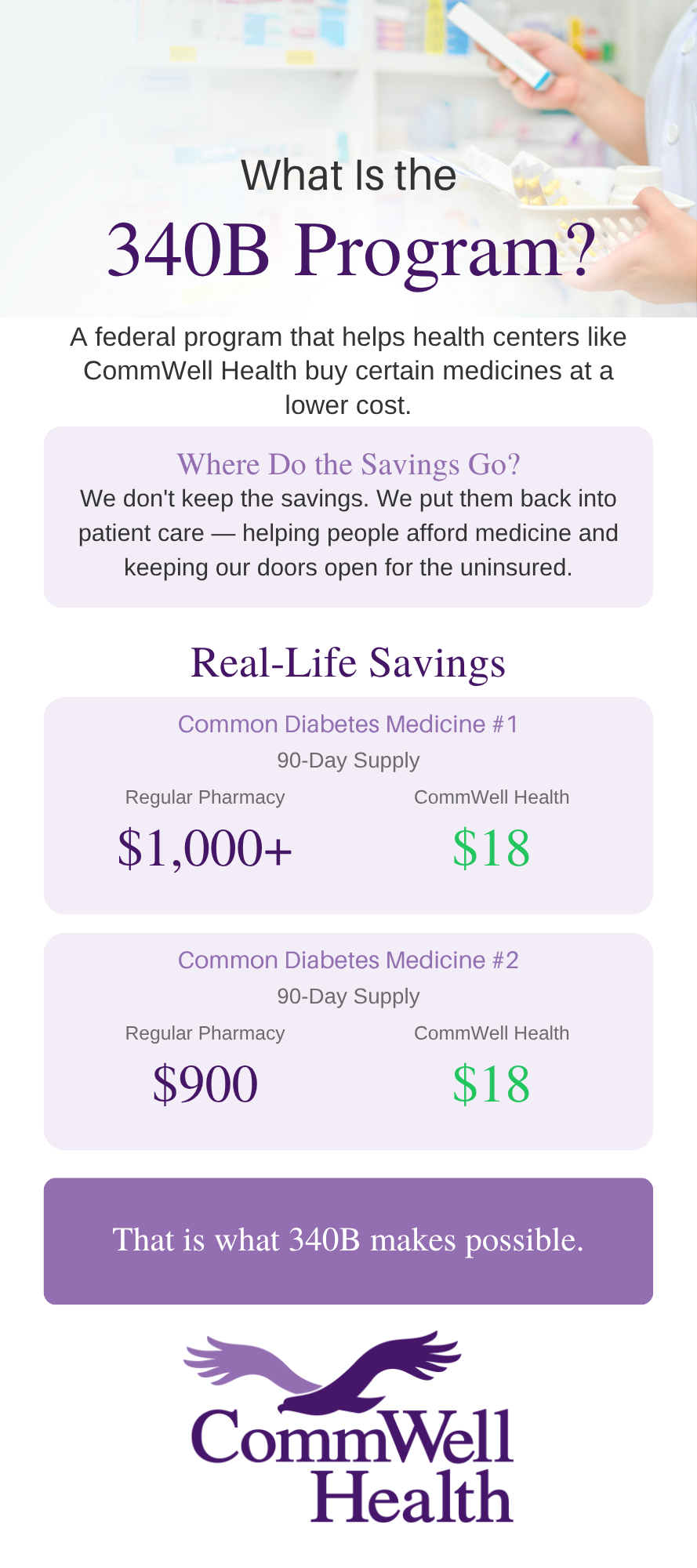
There is a federal program that helps bridge that gap. It is called 340B, and it allows health centers like CommWell Health to buy certain medicines at a lower cost. We do not keep those savings — we put them back into patient care. We use them to help people afford their medicine and to keep our doors open for patients who have no insurance, or whose insurance still leaves them with bills they cannot pay. Here is what that looks like in real life: a 90-day supply of a common diabetes medicine can cost over $1,000 at a regular pharmacy, and another common diabetes pill runs close to $900. At CommWell Health, patients on our sliding fee scale pay as little as $18 for those same medicines. That is what 340B makes possible.
At CommWell Health, every patient receives high-quality care regardless of what they can pay. We set our fees based on income, and we serve patients with insurance, patients without insurance, and patients whose insurance still leaves them with costs they cannot afford. That is the standard every community health center is held to, and it is one we are proud to meet.
CommWell Health runs its own in-house pharmacy, so patients can get their medicine right where they receive care. For patients who cannot easily make the trip, the CommWell Health Foundation — supported by generous donations from our community — covers the cost of shipping. Patients still pay our discounted 340B price for their medicine, but the shipping arrives at no extra charge. That is one more way we try to make it easier for people to get the care they need.
In recent years, drug companies have placed new limits on how health centers can use the 340B discount. For some medications, that means patients pay more. For others, the full price is so high that without 340B, we simply could not afford to carry them. Some patients would delay a prescription or skip doses. Other patients would have no option to fill their prescription at all.
Drug companies make medicines that save lives, and we see the value of that work every single day. But when patients cannot afford the medicines they need, everyone pays a price — and that is a cost no patient should have to carry alone.
When people cannot afford their medicine, they get sicker. And when they get sicker, they often end up in the emergency room. That costs far more — for the patient, for the community, and for taxpayers. Keeping people healthy at their local health center is far less expensive than treating a preventable crisis at a hospital. The 340B program is a big part of what makes that possible.
North Carolina lawmakers need to protect this program. They should ensure that health centers can continue serving patients the way CommWell Health does — with affordable medicine, close to home, where cost is not the reason someone goes without. Drug companies, insurance middlemen, and others in the health care system should not be allowed to weaken something that helps people afford the medicine they need.
Here is why this matters to us personally. A patient came to CommWell Health after losing her job and her health insurance. She had a chronic illness and needed medicine every month to stay healthy. Without help, her prescriptions cost more than $1,300 a month — a bill no one could manage after losing a paycheck. Through the 340B program, we helped her access those same medicines for under $200. She stayed on her treatment plan. She stayed healthy. She got back on her feet. That is what this program does for real people in real hard times, and North Carolina should protect it.
By:

And